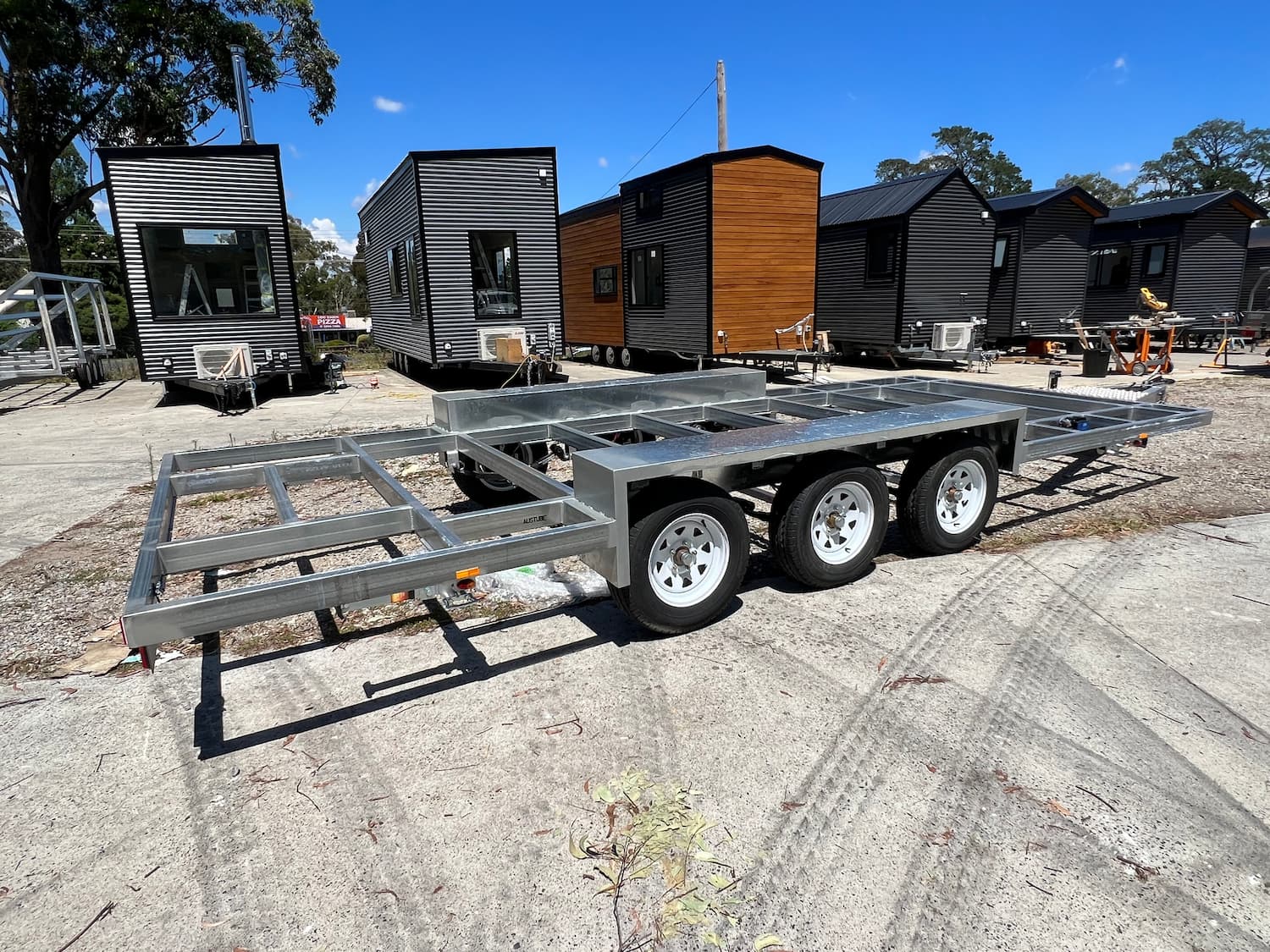
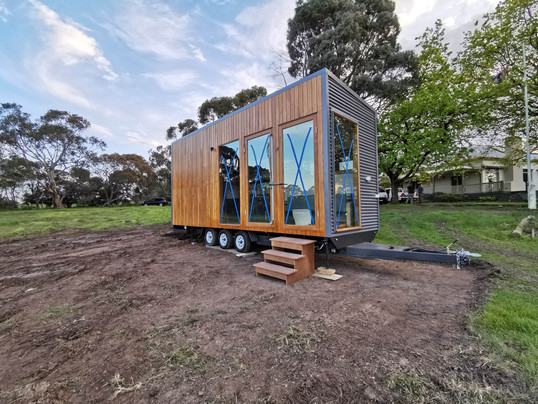
If a tiny home is a body, the trailer is the spine. Get the base right and everything above it becomes easier, safer and often cheaper to build. Get it wrong and you will fight head height, door placement, plumbing runs and tow weights for the rest of the project.
This guide unpacks how we at Tiny Homes by Hangan and our fabrication partner Hangan Steel think about road-legal tiny house trailers for Melbourne and Victoria. You will learn the difference between Flat Top and Drop Deck, how wheel boxes change layouts, what axle ratings actually mean, and which braking and registration choices keep your build compliant and towable.
Whether you are an owner-builder buying a trailer-only, or you want us to deliver a lock-up shell or turnkey home, this is the practical, nerdy-helpful overview we give people during a factory tour.
Flat top vs drop deck: what changes inside the house
Both are square, level platforms custom-fabricated to your plan. The choice affects everything from loft head height to door and bathroom placement.
- Flat Top: The deck runs level across the full width with no wheel boxes intruding into the floor area. That freedom makes it ideal for flexible room placement, wide sliding doors and continuous cabinetry. It is our go-to when you want a single-level layout, a downstairs bedroom, or maximum freedom to position doors along the sides.
- Drop Deck: The deck drops down between the wheels to gain extra internal head height through the central run. You keep slim wheel boxes above the wheels, which you can hide in joinery or seating. If you want a lofted bedroom, tall occupants, or a generous shower without raising your roof, a Drop Deck is usually the better pick.
In practice, we often recommend:
- Lofted bedroom, mezzanine lounge or tall shower, pick a Drop Deck.
- Single-level studio, large stacking doors or frequent door relocations, pick a Flat Top.
Wheel boxes, head height and the loft you actually want
Wheel boxes on a Drop Deck are not dead zones. We treat them as ready-made plinths for:
- Kitchen base cabinets
- Banquette seating or a daybed
- Elevated plant platforms or toe kicks for tall wardrobes
Because the centre aisle sits lower, you gain valuable internal height without busting road-legal limits. That extra headroom is what makes a comfortable loft possible while keeping to common transport height constraints. It also eases stair pitch and lets us avoid awkward crawl spaces.
Door placement and services planning
Flat Tops make side-door placement easy anywhere along the run because you do not have to bridge wheel boxes. Drop Decks are still flexible; we either step the threshold across a wheel box or cluster doors where the deck is lowest. Early conversations about where you want the main entry, bathroom and kitchen help us place cross-members, plumbing penetrations and wiring conduits so you keep floor insulation continuous and avoid cutting into structural steel later.
Axles, weights and the ratings that matter
Trailer ratings are about the loaded weight of the trailer and house combined. We match trailers to your intended finished weight and usage, then add prudent margin.
Published retail trailer pricing with Hangan Steel, for budgeting:
- 3 Tonne, dual-axle: Flat Top $9,490; Drop Deck $9,990
- 3.5 Tonne, dual-axle: Flat Top $10,790; Drop Deck $11,290
- 4.5 Tonne, tri-axle: Flat Top $13,490; Drop Deck $13,990
- 4.5 Tonne, tri-axle (alt spec): Flat Top $13,990; Drop Deck $14,490
- 4.5 Tonne, tri-axle (higher spec): Flat Top $15,490; Drop Deck $15,990
- 10 Tonne, truck axle for 11 m builds: Flat Top $41,490; Drop Deck $42,490
Typical use cases:
- 3 Tonne dual-axle for compact studios and ultra-light builds.
- 3.5 Tonne dual-axle when you want a little more fit-out and glazing.
- 4.5 Tonne tri-axle for most 6 m to 9 m homes with full amenities.
- 10 Tonne truck-axle chassis for 11 m homes that need air brakes and break-away systems.
We factor the Gross Vehicle Mass (GVM) against your design, cladding, windows, plumbing and storage to select the right axle set, leaf springs and braking package.
Brakes, registration and towing realism
Electric brakes are standard on many of our towable trailers. For 11 m builds and heavy applications, we use truck axles with air brakes and integrated break-away systems. Registration can be arranged to meet Victorian road requirements as a registerable moveable dwelling or custom caravan, and we size lighting, coupling, safety chains and compliance plates accordingly.
Towing considerations:
- Many customers can tow smaller trailers with an appropriately rated vehicle and licence. Always confirm your vehicle tow rating, ball weight limits and state regulations.
- Larger tri-axle and truck-axle builds are typically moved by professional tow operators. Even if your vehicle can move the load, we recommend pro transport for long distances to protect finishes and tyres, and to manage braking performance on grades.
If you plan to move frequently, tell us early. We will bias materials and detailing toward travel, from window selection to service connections and skirt clearances.
How custom sizing works
Every trailer is fabricated to your plan. Standard exterior cladding width is 2.4 m to stay within common transport width while allowing cladding and flashings. Lengths typically range from 4 m to 11 m. We draw frame plans to your interior layout, place cross-members under major loads, and coordinate penetrations for plumbing and electrical rough-ins. That is how you get a square, level base that sheets cleanly and stays water and weatherproof at lock-up.
Owner-builders often start with a trailer-only or trailer plus steel-frame kit. Others engage us for a lock-up shell, then complete interiors themselves as a cost effective measure. If you prefer hands-off, our turnkey path covers the full build through to handover.
Simple trailer selector
- Small studio or office up to about 6 m, flexible door placement, minimal travel: Flat Top, 3 Tonne to 3.5 Tonne dual-axle.
- 6 m to 9 m home with a loft and full amenities: Drop Deck, 4.5 Tonne tri-axle.
- Downstairs bedroom, big sliders, single-level living: Flat Top, 4.5 Tonne tri-axle.
- 11 m statement build with generous lofts and storage: Drop Deck or Flat Top on 10 Tonne truck axles with air brakes.
Not sure where you land? Bring your sketch or Pinterest board to a one-on-one factory tour and we will map it to a chassis in minutes.
Layouts mapped to trailer choices
- Lofted bedroom above kitchen or bathroom: Drop Deck for extra headroom through the centre and cleaner stair geometry.
- Split-level living with banquette seating: Drop Deck, using wheel boxes as built-in plinths.
- Large side-opening doors to a deck for a studio vibe: Flat Top to keep thresholds simple and uninterrupted.
- Accessible or step-minimised plan with a downstairs bed: Flat Top with continuous floor height.
Are tiny houses sturdy and safe?
Yes, when they are built like houses and engineered like caravans. Our chassis are purpose-built in duragal steel, with cross-bracing, correct coupling and safety chains, compliant brake systems and properly rated axles. The house above uses building-grade framing, insulation, window flashings and cladding. Safety also depends on weight distribution, tie-down points and correct load securing during transport, which we design for and show you at handover.
Maximum size and road limits in Victoria
Most of our road-legal homes use a nominal 2.4 m exterior width and stay within common transport height limits so you can move them with appropriate registration and permits. Overall length options run from 4 m to 11 m depending on the chassis. Regulations can vary, and oversize moves may require pilot vehicles or permits, so always check current Victorian requirements and speak to your local council about where and how long you can site a tiny home.
Life expectancy
With proper maintenance, a tiny home can last decades. The chassis is galvanised and sealed, the envelope is water and weatherproof at lock-up, and windows, doors and cladding are selected for Australian conditions. Like any dwelling, scheduled maintenance on sealants, fasteners, paint, brakes and tyres will extend service life.
FAQ
- What kind of trailer is best for a tiny house?
- For lofts and taller users, a Drop Deck usually wins. For single-level plans and flexible door placement, a Flat Top is hard to beat. Weight and length then set the axle and brake spec.
- Can anyone tow a small trailer?
- You need the right vehicle rating, licence and hitch set-up. Many people can tow compact, lighter builds, but always confirm legal limits. For larger homes, use professional transport.
- What is the maximum size a tiny house can be?
- Practically, we build 4 m to 11 m lengths within common transport width and height. Oversize moves are possible with permits. Check Victorian rules and your route in advance.
- Are tiny houses sturdy and safe?
- When engineered and built correctly, yes. We pair a compliant trailer with a building-grade envelope and guide you on weight distribution and tie-downs.
- What is the life expectancy of a tiny house?
- Built on a galvanised steel chassis with quality materials, a tiny home can serve for decades with routine maintenance.
Next steps
If you are comparing Flat Top vs Drop Deck or deciding between a 3.5 Tonne dual-axle and a 4.5 Tonne tri-axle, seeing the chassis in person helps. Explore our road-legal tiny house trailer options on the trailers page, then book a one-on-one factory tour in Bayswater to match a chassis to your sketch, budget and towing plan. If you want a complete build rather than DIY, our team can guide you from trailer-only to lock-up or turnkey.
- Compare chassis options and pricing on our trailers page: see our road-legal tiny house trailer options at https://tinyhouse.com.au/tiny-home-trailers/
- Book a factory tour to see builds in progress and talk through layouts: https://tinyhouse.com.au/book-a-tour/
For broader inspiration or to enquire about a custom build with a Melbourne tiny house builder, start here: https://tinyhouse.com.au/